From Sign-Ups to Starters: Activating Micro-Creators Through AI-Guided Monetisation

From Sign-Ups to Starters: Activating Micro-Creators Through AI-Guided Monetisation

Duration

1 month

My Role

UX Research / Design

Project Type

AI Feature Ideation

Project Focus

UX Research, UI Flow, Prototype, User Testing

Background

Portaly is a creator monetisation platform that helps individuals turn their content, skills, and personal brands into income streams.


By late 2023, the platform was experiencing strong creator sign-up growth. However, this growth masked a critical gap: many new users were joining — but very few were successfully monetising.


A significant portion of creators completed profile setup but never launched a paid offering. The journey from sign-up to first revenue felt distant, unclear, and overwhelming — especially for early-stage micro-creators exploring monetisation for the first time.

Activation Problem

At Portaly, an “activated creator” was defined as someone who launched at least one monetisable product or service within 14 days of sign-up.


However, behavioural and growth data revealed major friction in this early journey:

  • Only 48% of creators launched a monetisation method within their first month.

  • Over 60% completed profile setup but never configured pricing or offerings.

  • Many became inactive within the first week.

  • Users repeatedly visited monetisation features without completing setup.

The Discovery

MONETISATION FEELS TOO BIG FOR MOST CREATORS

Our initial hypothesis was that creators needed better awareness of Portaly’s monetisation features.

However, interviews revealed a deeper barrier: early-stage creators weren’t stuck because they lacked tools — monetisation felt intimidating, ambiguous, and high-effort.


“It takes too much time to make it look good… the pull isn’t strong enough, so I gave up halfway.”

“Selling makes me anxious. Promoting it through posts and stories over and over feels scary.”

“I’m not confident pricing my work — I worry I’ll charge too much.”

Across creator types, we saw a consistent pattern: creators wanted low-pressure ways to earn but struggled with the first step. Many gravitated toward lightweight monetisation (donations, affiliate links) rather than building full products.


This reframed our challenge — not feature discoverability, but helping creators build clarity and confidence through small, actionable steps.

Deeper Insights

MONETISATION NEEDS A FIRST STEP — NOT MORE FEATURES

MONETISATION NEEDS A FIRST STEP — NOT MORE FEATURES

Working with product data and conducting creator interviews across different content verticals, we investigated early monetisation behaviours on Portaly. Both qualitative and behavioural insights revealed why most creators stalled before activating monetisation:

  • Most creators didn’t lack monetisation ideas — they lacked clarity on what was realistic to launch first.

  • Creators perceived monetisation as a “big leap” rather than a series of small steps.

  • Many hesitated to price their offerings, fearing they would charge too much or provide too little value.

  • Time and effort to set up monetisation pages felt disproportionately high compared to expected returns.

  • Creators preferred lightweight monetisation methods (e.g. donations, affiliate links) over building full products.


Early monetisation intent existed — but without guidance, it rarely translated into action.

Design Challenge

MAKE EVERY CREATOR START

MAKE EVERY CREATOR START

Our goal was to transform onboarding from passive setup into an activation journey — helping creators move from vague ideas to tangible monetisation actions.


We focused on three strategic outcomes:

  1. Lower the barrier to monetisation

  2. Turn ideas into actionable plans

  3. Build confidence through early momentum

The Solution

MAKE MONETISATION FEEL DOABLE

MAKE MONETISATION FEEL DOABLE

We focused on reducing the psychological and practical barriers preventing creators from taking their first monetisation step. Rather than adding new features, we guided creators to activate Portaly’s existing tools with clarity and confidence.
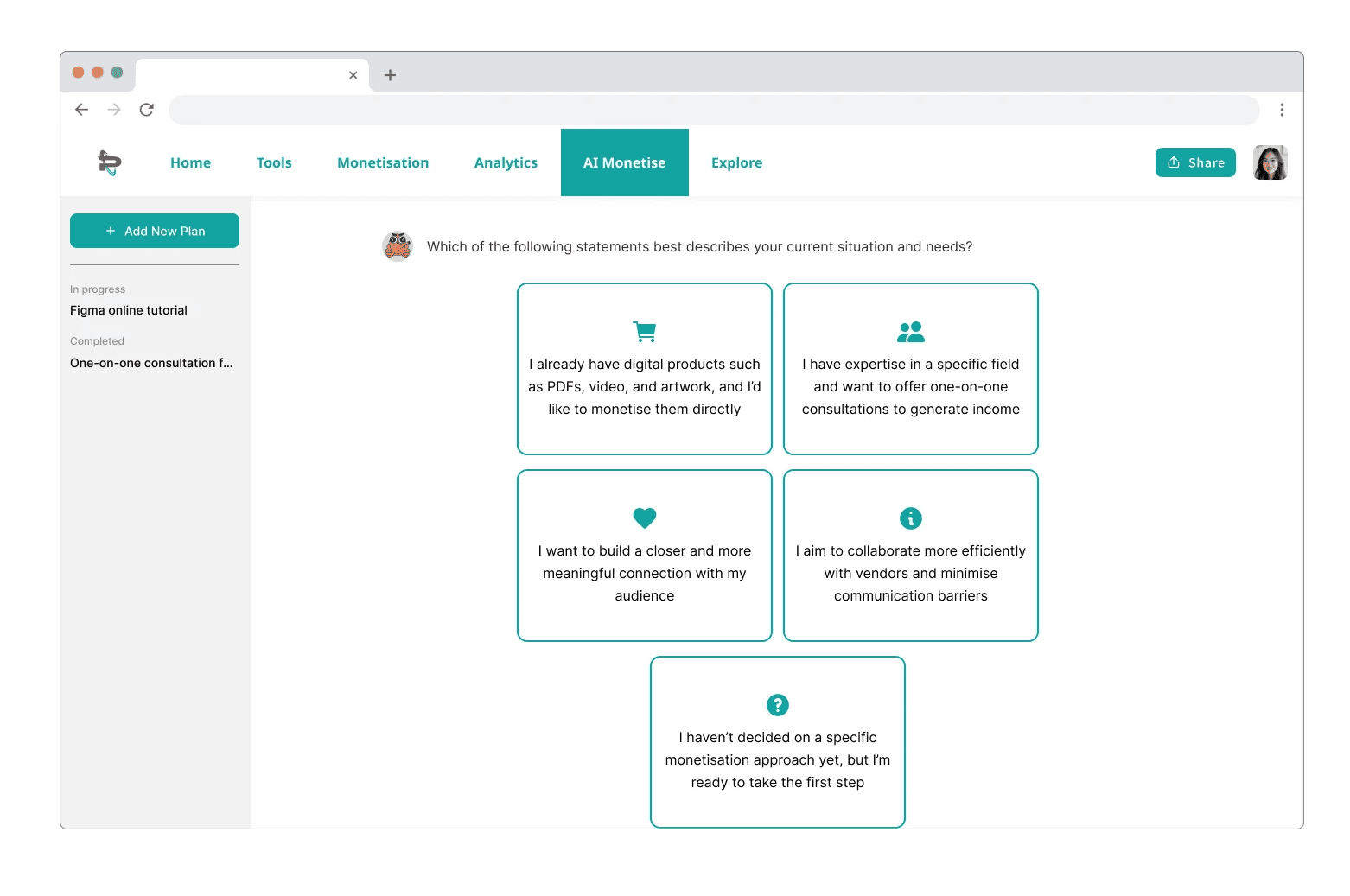
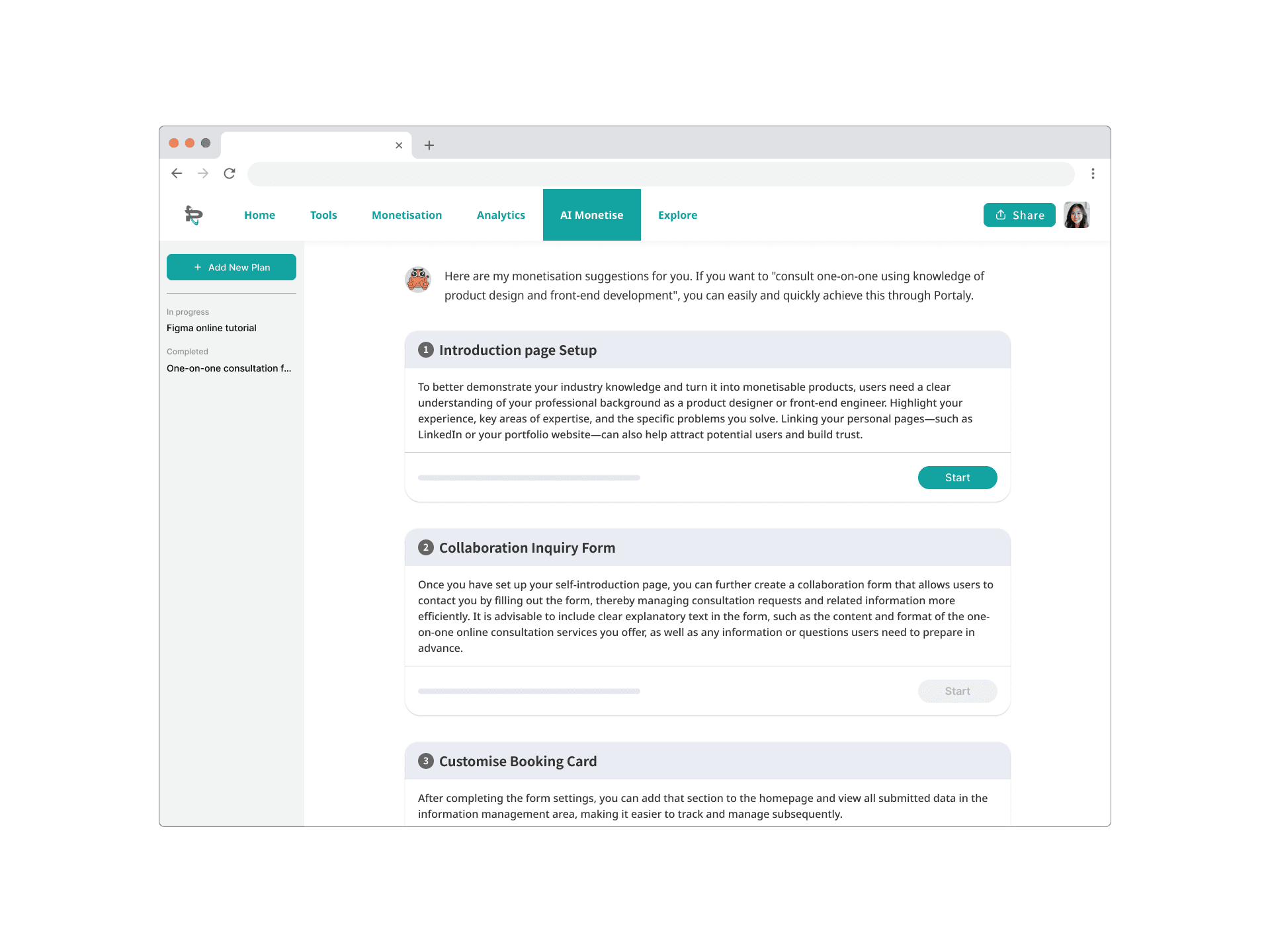
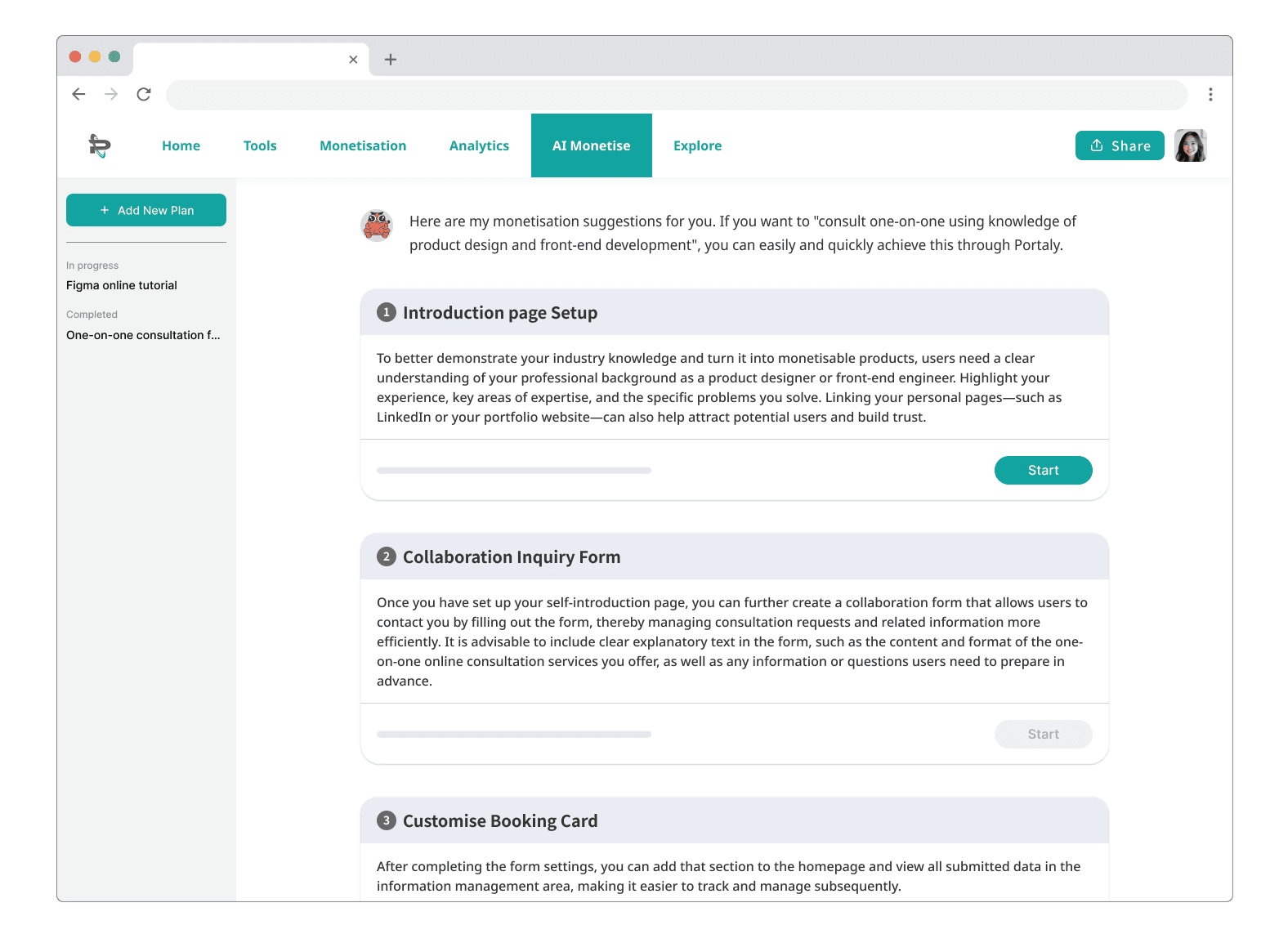
Guided Monetisation Portal

We introduced a dedicated monetisation entry point within Portaly.


  • Used a conversational chat to narrow options

  • Matched creators with relevant monetisation paths

  • Reduced cognitive overload by limiting choices

Instead of exploring features, creators were guided toward a starting point.

Small-Step Activation Design

We broke monetisation into manageable, low-commitment tasks.

  • Turned vague ideas into simple action plans

  • Designed step-by-step setup flows

  • Enabled progress anytime, even in short sessions

Monetisation shifted from a big leap to a series of small, achievable steps.

Dedicated Monetisation Portals within Portaly

Start with a conversational chat that provides limited options matching Portaly’s existing tools, reducing cognitive load for users.

Step-by-Step Tasks Designed for Busy Creators

Allow users to complete monetisation tasks in small, guided steps — enabling progress anytime, even during short breaks.

Ideation With Brainstorming

Facilitated the team in turning countless potential ideas into small, implementable solutions

As the lead UX designer, I guided the team through an affinity diagram activity. Based on the insights we gathered, we defined a clear POV to align our direction and stay focused on solving the real problem.

I decided to apply the IDEO brainstorming method to expand our ideation process across ten different aspects. We generated a large number of ideas and conducted several rounds of voting, guided by evaluation metrics. This process helped us converge on a clear, core problem to solve.

Design Process

Product & Competitor Analysis

Product & Competitor Analysis

  • Reviewed monetisation usage data and activation patterns

  • Analysed existing monetisation tools within Portaly

  • Conducted competitive benchmarking across creator platforms

This helped us understand where users were dropping off — and where monetisation opportunities existed.
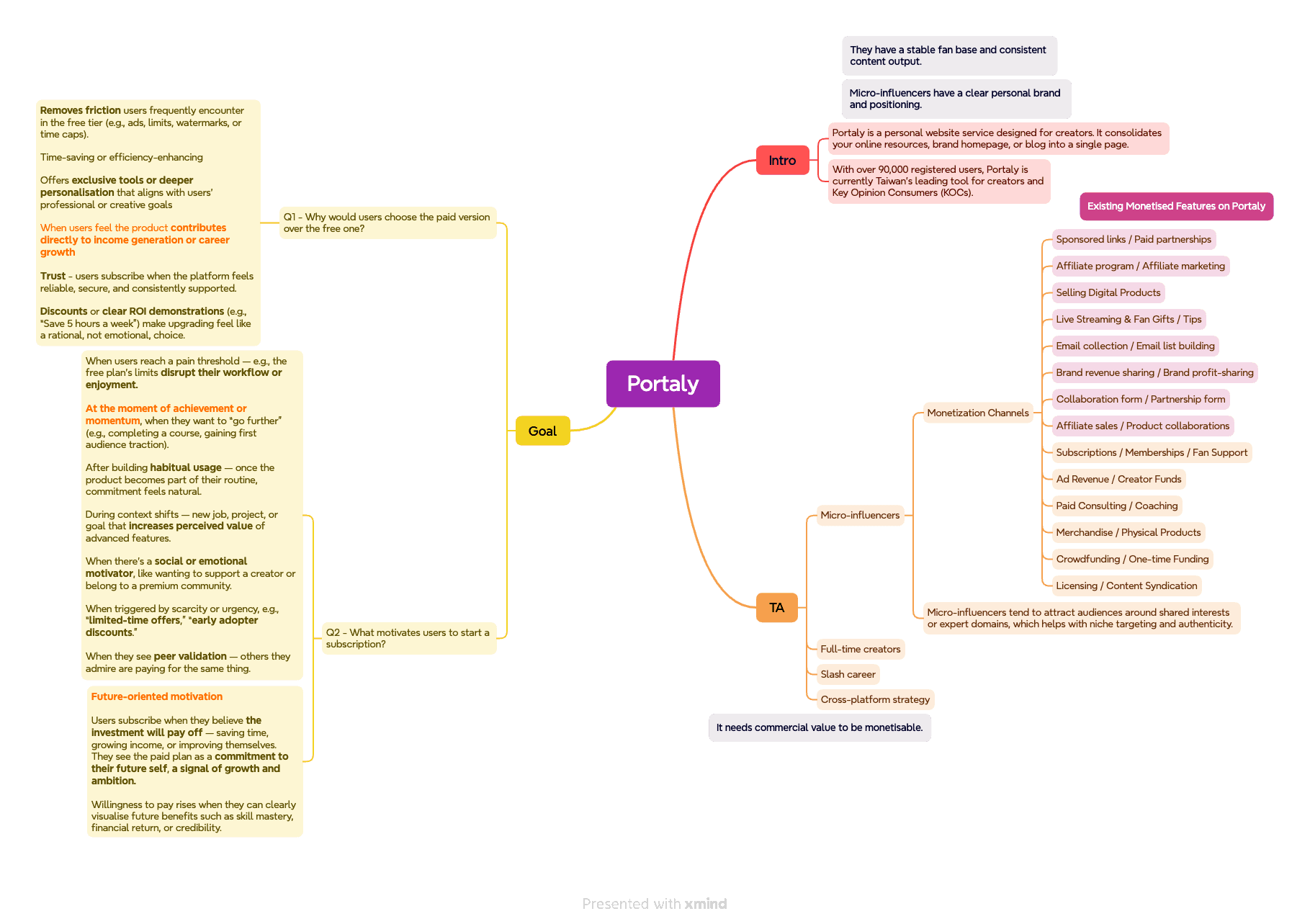
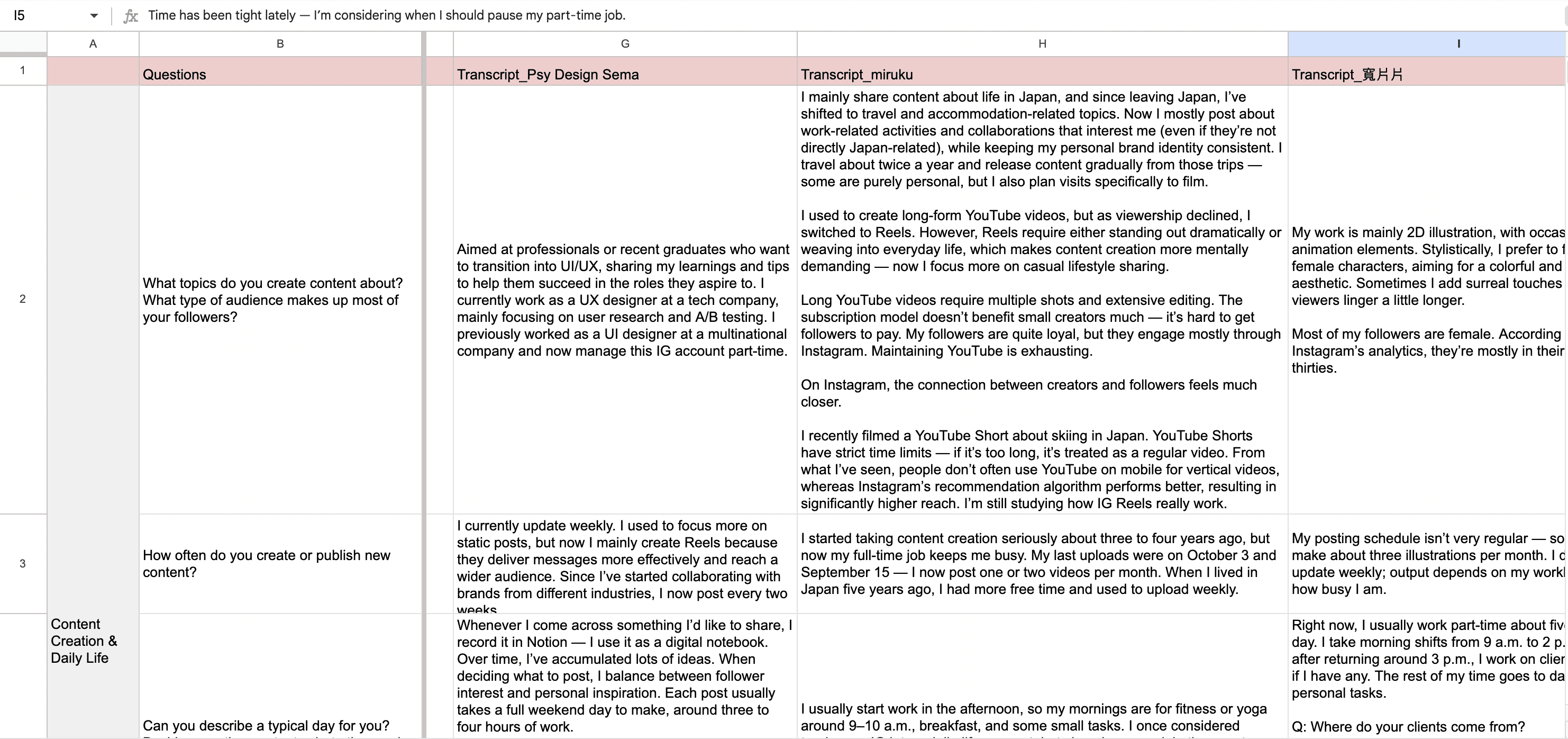
User Interview & Affinity Diagram

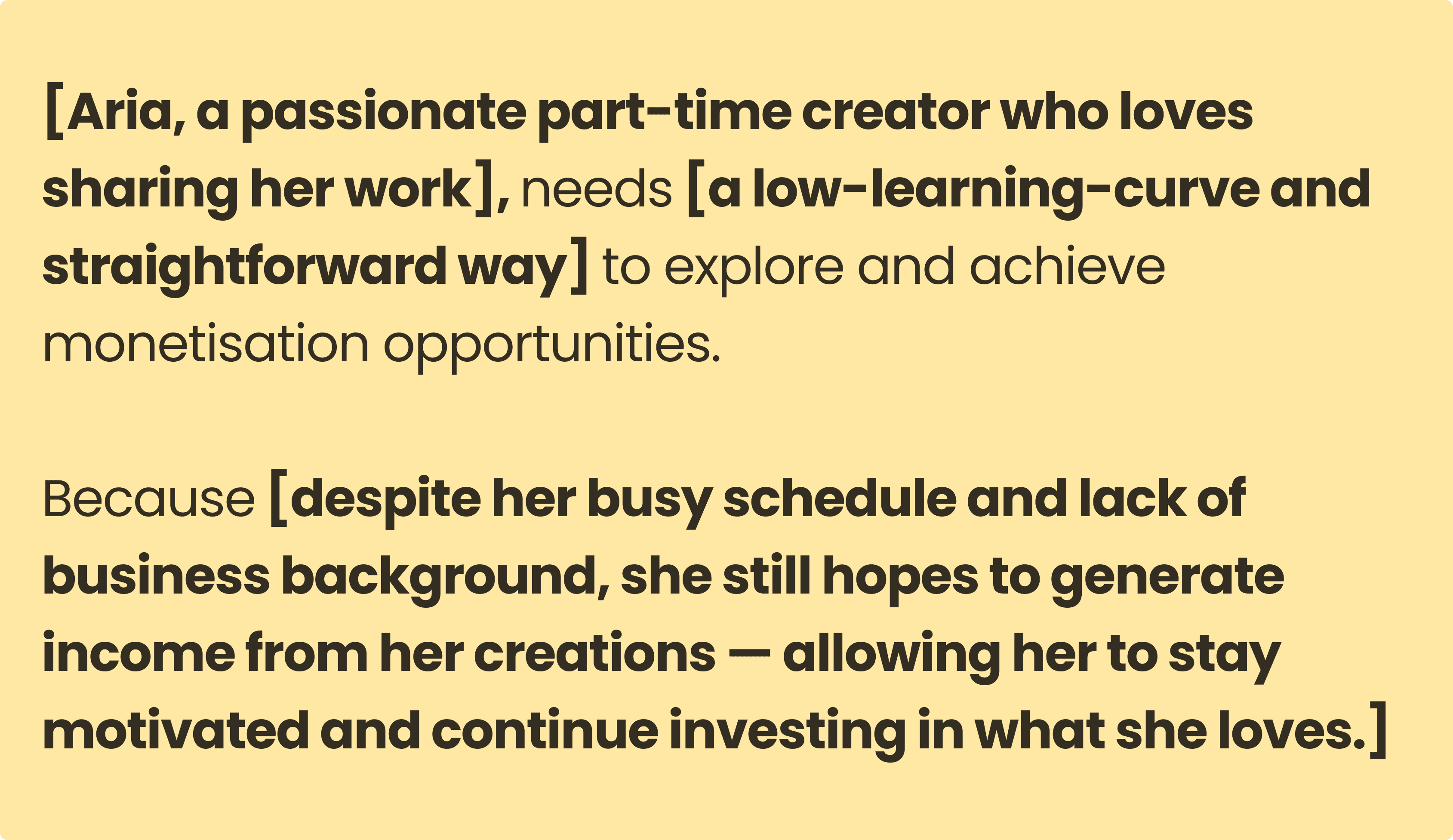
Reframe HMW - How might we help part-time creators identify, structure, and activate their existing assets into monetisable formats — while keeping motivation and clarity high?

Many part-time or non-full-time creators already possess valuable creative assets — content, skills, or audiences — but struggle to turn them into sustainable income because they lack clear motivation, structure, and monetisation planning.

We conducted eight user interviews, transcribed and analysed the results using an affinity diagram, which helped us gain clarity on how we could tangibly address users’ pain points and create real value.

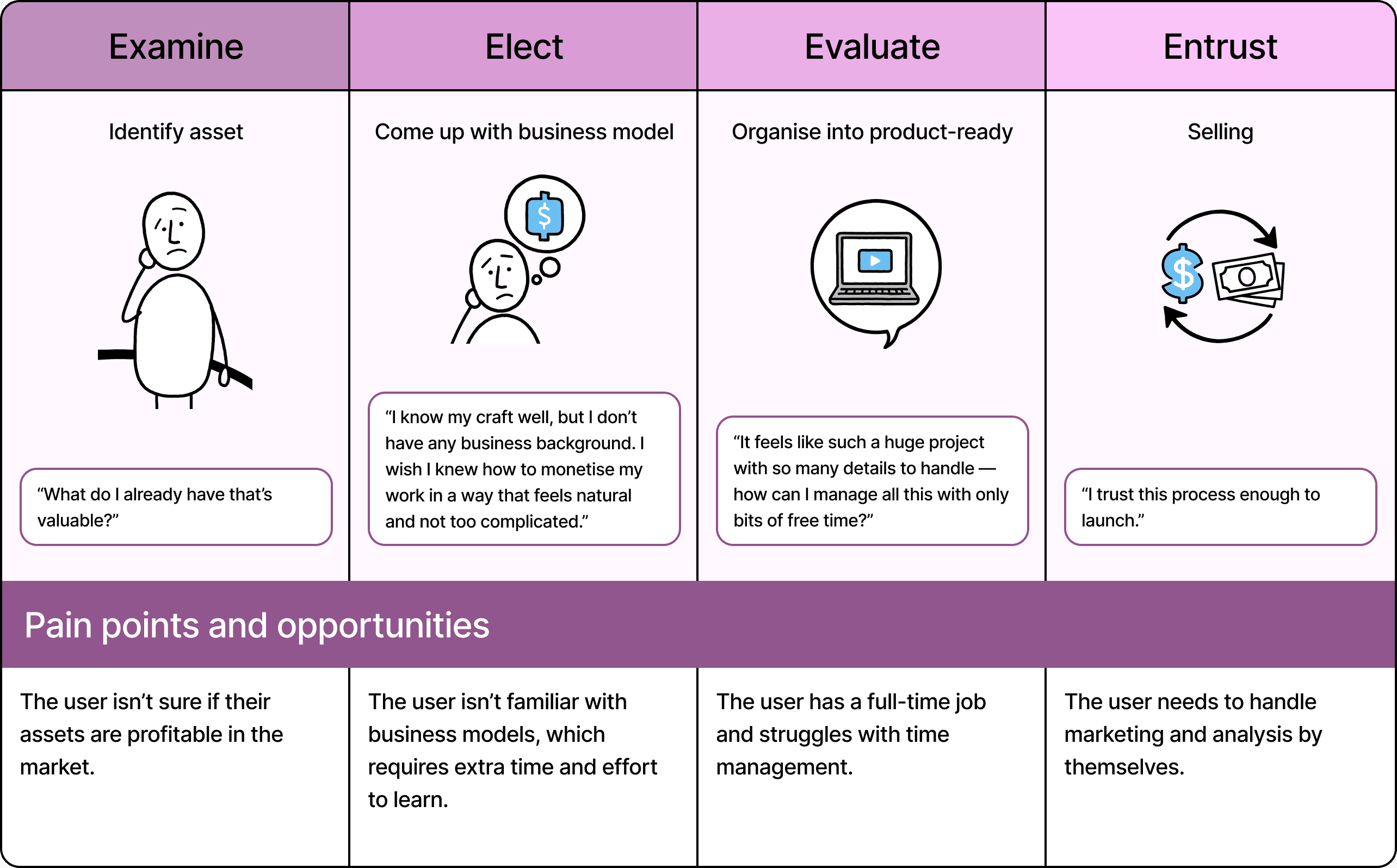
Solution along the user journey & flow

An AI assistant that simplifies monetisation planning, breaks goals into tasks, and tracks progress

Breaking down the user journey to visualise key pain points and opportunities.

Design - Key Features

AI-powered monetise analysit, transform a vauge idea into actionable steps within the platform existed feature, reduce the uncertainty as friction while strenghthen user retension

Currently transforming the Prototype with Figma Make, will update the interactive prototype here soon!

User Research

  • Conducted 8 in-depth creator interviews

  • Explored monetisation readiness, behaviours, and barriers

  • Transcribed sessions and synthesised insights

We used affinity diagramming to identify recurring pain points and activation gaps.

Reframing the Opportunity

We reframed the challenge through a core design question:


How might we help part-time creators identify, structure, and activate their existing assets into monetisable formats — while maintaining motivation and clarity?


Many creators already had valuable assets — content, skills, audiences — but lacked the structure and confidence to monetise them.

Reframing the Opportunity

Facilitated cross-functional brainstorming sessions

  • Applied IDEO ideation methods to expand solution space

  • Conducted multi-round voting using evaluation criteria

  • Defined POV statements to align direction

This process helped us converge on practical, low-barrier activation solutions.

Journey Mapping & Experience Design

Journey Mapping & Experience Design

  • Mapped the end-to-end monetisation journey

  • Identified friction points and drop-off moments

  • Visualised opportunities for guided intervention

This led to the concept of an AI assistant that could simplify planning and guide action.

Interactive Prototyping

Interactive Prototyping

  • Designed an AI-powered monetisation planning experience

  • Transformed vague ideas into structured action steps

  • Embedded guidance within existing platform features

  • Focused on reducing uncertainty and increasing activation

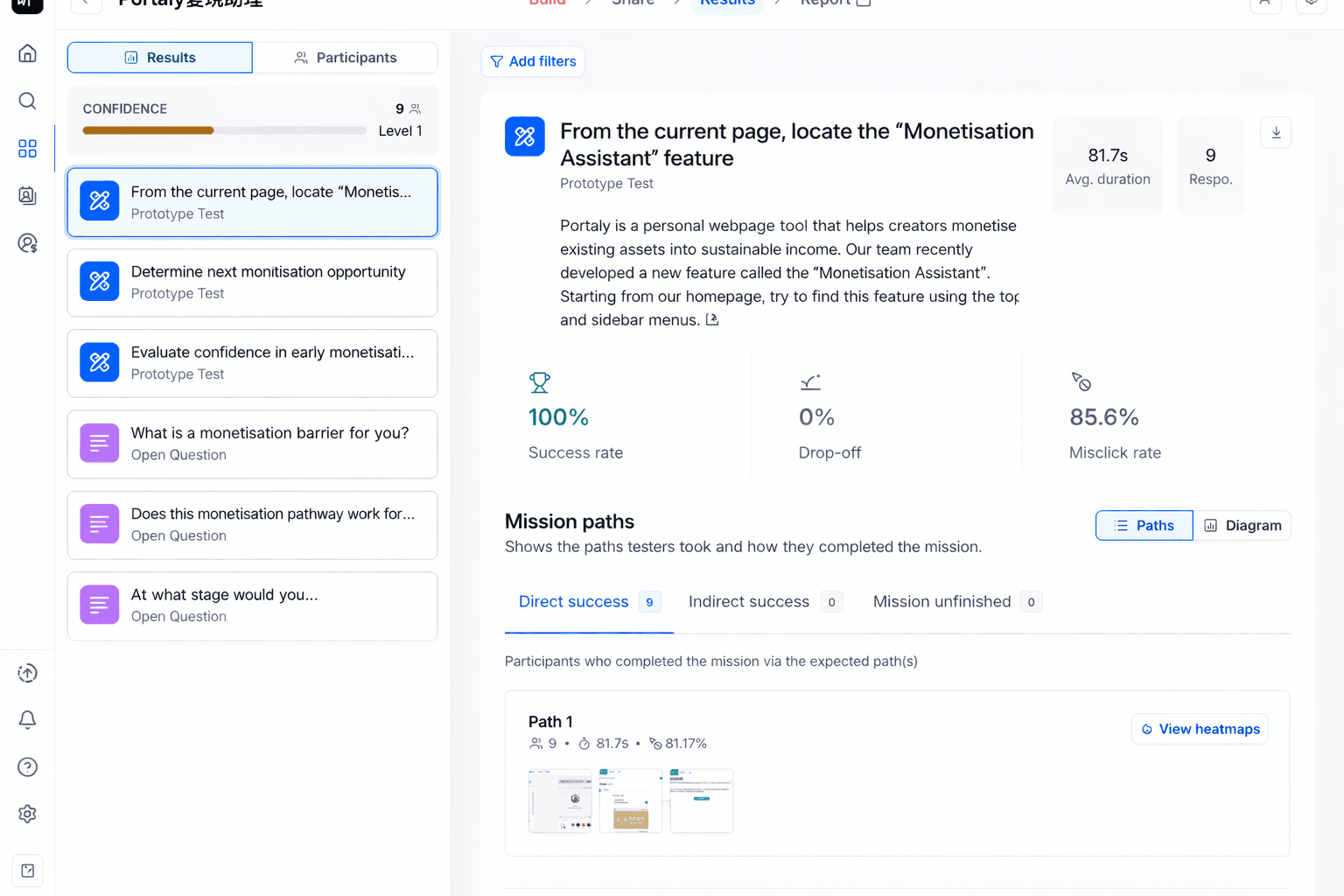
User Testing

User Testing

We conducted moderated usability testing with 9 creators to evaluate clarity, usability, and perceived value of the AI-guided experience.


  • Tested comprehension of conversational prompts

  • Observed hesitation and drop-off moments

  • Gathered qualitative satisfaction feedback


Iterations on prompt clarity and guidance structure led to measurable improvements in user engagement and overall experience satisfaction.

Impact

TURNING SIGN-UPS INTO MONETISING CREATORS

LOWERING THE FIRST STEP TO UNLOCK ACTION

By introducing guided monetisation planning and breaking down complex goals into small, actionable steps, we helped early-stage creators move from passive sign-ups to active platform users.


Within the first release cycle, we observed meaningful improvements in first-month engagement:

  • Return rate: 52% → 8%

  • Monetisation launch: 48% → 56%


These shifts signalled stronger early momentum — as structured guidance and reduced cognitive load helped creators turn intention into action.